



Shallow Well Sampling Pumps
Peristaltic and inertial pumps built for monitoring wells, piezometers, and drive points – from a few feet to 100 feet deep. Trusted by environmental professionals across North America since 1985.

Built for sampling, not water supply
Shallow well sampling has its own physics, its own challenges, and its own catalog of purpose-built equipment. Most “shallow well pumps” on the consumer market are residential pumps that lift household water out of a well less than 25 feet deep. The pumps on this page do something different. Their job is to pull a small, representative water sample out of a shallow monitoring well without altering its chemistry – for environmental site assessments, contamination investigations, and regulatory compliance.
Everything on this page is built for monitoring wells, piezometers, and drive points. Not household supply.
What makes shallow sampling its own discipline?
Shallow well sampling isn’t just deep well sampling with a shorter tubing run. The constraints are different, and so is the right tool.
Suction lift is a hard physical ceiling. Most peristaltic pumps can’t lift water more than about 28 feet regardless of how big or powerful the pump is. The theoretical limit of suction at sea-level atmospheric pressure is 33.9 feet. For bigger lifts, the choice is an inertial pump or a submersible. Above it, peristaltic is often the cleanest option if loss of volatiles is not a concern.
Volatile loss matters more. A lot of shallow well sampling work targets volatile organic compounds, fuel hydrocarbons, metals and emerging contaminants like PFAS. Pump choice and tubing choice directly affect whether a sample comes out defensible. Peristaltic pumps paired with low-sorption tubing are well-suited to low-flow and micro-purge protocols – the pump head stays out of the well entirely, and only the dedicated tubing contacts the sample. BUT they are not suitable for volatile sampling because the suction aspect of the pump releases the volatiles.
Cross-contamination risk is high. Shallow wells are often clustered close to contamination sources – fuel station tank fields, dry cleaners, brownfield redevelopments, agricultural impact zones. Dedicated tubing, and slim pump profiles for narrow casings matter as much in shallow work as they do at depth.
Drive points and 1-inch casings change the equation. A lot of shallow groundwater work happens through 1-inch drive points or narrow piezometers. Most standard sampling kits don’t fit. Waterra’s inertial Nano Flow and Micro Flow systems were built specifically for that constraint.
Waterra shallow well sampling pumps at a glance
| Pump | Type | Max depth | Best for |
|---|---|---|---|
| 1-UP Peristaltic Sampling Pump | Peristaltic | ~27 ft | Adjustable flow rates and low flow shallow wells |
| Spectra Fielld Pro | Peristaltic | ~27 ft | Adjustable flow rates and low flow shallow wells |
| Nano Flow System | Waterra Inertial | 50 ft (15 m) | Drive points, narrow/collapsed wells |
| Micro Flow System | Waterra Inertial | 75 ft (23 m) | Drive points, narrow/collapsed wells |
| Submersible WP40 Submersible WP60 Submersible WP90 | 12V submersible | 40 ft (12 m) 60 ft (18 m) 90 ft ( 27 m) | Battery-powered shallow sampling |
| Low Flow System | Waterra Inertial | 100 ft (30 m) | Piezometers at the deeper edge of shallow |
Featured pumps
Waterra 1-UP Peristaltic Sampling Pump
Peristaltic • Up to ~27 ft suction lift
The anchor of Waterra’s shallow well sampling range. The 1-UP delivers controllable, low-flow rates suited to low-flow and micro-purge protocols – and the pump head sits at the surface. With dedicated tubing in each well, cross-contamination risk drops to near zero. The natural first choice for sampling in true shallow wells.
Best for: water source monitoring, near-surface contamination investigations, low-flow protocols in wells under 25 feet.


Spectra Field Pro Peristaltic Pump
Peristaltic • Up to 27 ft (8 m)
Same suction-lift range as the 1-UP, different form factor.
Best for: shallow sampling programs
Waterra Pump Nano Flow System
Inertial • Up to 50 ft (15 m)
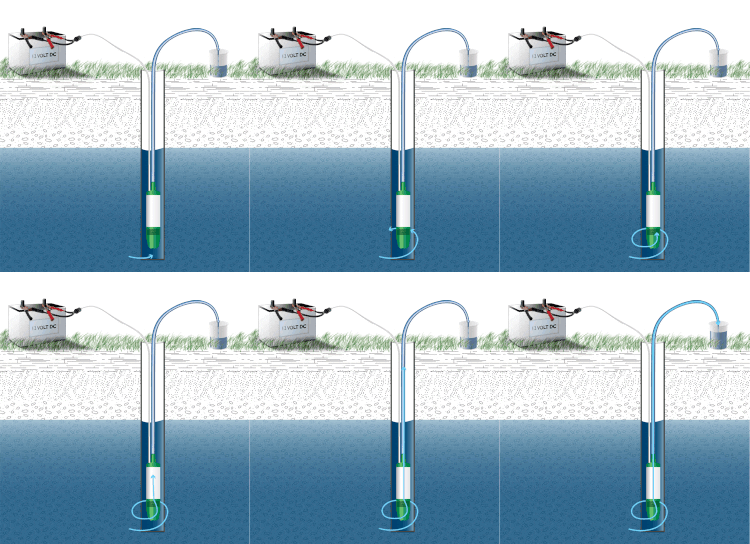
Designed for 1-inch drive points and narrow piezometers, the Nano Flow is the system that fills the gap below peristaltic suction lift. It’s inertial, so no electricity is needed in the field – actuate manually. It can be paired with the Hydrolift. Can be a life saver for collapsed or congested wells. Field-essential for Phase II ESAs at sites with drive-point networks.
Best for: 1-inch drive points, narrow piezometers, Phase II ESA sampling between 25 and 50 feet.

Waterra Pump Micro Flow System
Inertial • Up to 75 ft (23 m)
The Micro Flow sits between the Nano Flow and the Low Flow systems in depth range and is sized for narrow or partially collapsed wells where larger-diameter tubing can’t pass.
Best for: Narrow or partially collapsed wells, mid-depth drive points, projects with mixed shallow depths.
Submersible Groundwater Sampling Pump (WP40, WP60, WP90)
12V submersible • up to 90 ft (27 m)
Waterra’s WP-12V submersible series are battery-powered, controllable flow rate, and a slim profile that fits 2-inch wells. The right tool when a sampling program calls for steady-rate pumping and the well is too deep for peristaltic but well within shallow range – for example, low-flow sampling in 2-inch monitoring wells between 25 and 90 feet.
Best for: Low-flow protocols in 2-inch wells where steady pumping is preferred over manual actuation.
How to choose the right shallow well sampling pump
Five questions get you to the right pump.
- How deep is your water?
- Under 25 ft → 1-UP or Spectra Field Pro peristaltic
- 25–40 ft → Micro and Nano Flow inertial and Submersible WP40
- 40–75 ft → Micro Flow or Nano Flow inertial and Submersible WP40 and WP60
- 75–100 ft → Low Flow or Micro Flow inertial and Submersible WP90
- What’s your well diameter?
- 1-inch drive point or piezometer → Nano Flow or Micro Flow
- 2-inch monitoring well → Any pump on this page
- 4-inch+ → Any Pump on this page
- What’s your sampling protocol?
- Low-flow / micro-purge → Waterra Peristaltic or Submersible WP40, 60 and 90
- Purge-and-grab → Inertial systems
- VOC-focused work → Inertial systems
- What are your priority analytes?
- VOCs, SVOCs, fuel hydrocarbons →Inertial preferred; pay attention to tubing selection
- PFAS → All pumps as PFAS is not an additive or knowing used in Waterra pumps
- Metals and general inorganics → All pump types appropriate; choice driven by depth and well diameter
- What power do you have on site?
- None / remote → Peristaltic or inertial (manual operation)
- 12V battery → Submersible WP40 or 1 UP if its internal battery is not functioning
- AC power available → Peristaltic with AC adapter, Hydrolift and inertial system for big programs
Still not sure? Talk to a Waterra specialist → – most reps have field experience and will spec a system to your project.
Where Waterra shallow well pumps are used
Waterra pumps are commonly used in:
- Phase II Environmental Site Assessments – shallow monitoring wells around fuel stations, dry cleaners, light industrial properties
- Underground storage tank (UST) investigations – drive-point networks and shallow monitoring wells around tank fields
- Brownfield redevelopment – shallow groundwater characterization before development decisions
- PFAS source-zone investigations – shallow sampling where pump material and tubing choice are critical
- Agricultural and nitrate monitoring – shallow water table sampling in rural and farm-adjacent contexts
- Drinking water source protection – shallow aquifer monitoring around municipal and private supplies
- Stormwater and infiltration studies – near-surface groundwater quality assessment around urban infrastructure
Trusted by groundwater professionals since 1985
Waterra invented the modern inertial sampling pump and has spent four decades building out a complete sampling toolkit – peristaltic, inertial, and submersible. Our pumps are used in EPA, ASTM, and ISO-aligned sampling programs across North America and worldwide. Every system on this page is:
- Field-proven in active compliance, assessment, and emerging-contaminants programs
- Decon-friendly – but due to the inexpensive nature of Waterra tubing it is generally advised to dedicate tubing to each well.
- Backed by parts and service – replaceable foot valves, tubing, and pump components keep systems in the field for years
- Made in North America with regional distribution from waterra.com (USA) and waterra.ca (Canada)
Get the right pump for your next project
You don’t need to guess. Send us your depth-to-water, well diameter, and sampling protocol, and we’ll spec a system in 24 hours.
Frequently Asked Questions
Approximately 27 feet at sea level. The limit isn’t the pump – it’s atmospheric pressure. A vacuum can only “pull” water up about 33.9 feet at perfect efficiency, and real-world pumps top out around 27 feet. For deeper wells, an inertial or submersible pump is the correct tool.
The pump creates a partial vacuum and atmospheric pressure pushes water up into it. The maximum theoretical lift at sea level is about 33.9 feet – the height of a water column that atmospheric pressure can support. Practical pumps achieve around 27 feet because no real vacuum is perfect and friction in the tubing reduces efficiency. The lift is less at higher elevations.
It is not advisable to use a peristaltic pump as the suction pulls the VOCs out of solution.
The Waterra Nano Flow and Micro Flow inertial system were designed specifically for narrow wells and drive points. Nano Flow reaches 50 feet, which covers most drive-point applications. For drive points beyond 50 feet or if bigger flow is required, the Micro Flow extends the range to 75 feet.
Use a peristaltic pump for true shallow wells under 27 feet and controlled low-flow sampling. Use an inertial pump when the well is deeper than peristaltic suction lift allows or when you need higher purge volumes.
No. Waterra pumps are precision instruments for environmental sampling and are not rated, designed, or supported as drinking water supply pumps. For residential shallow well water pumps, contact a domestic well services supplier.
Use dedicated tubing per well wherever possible. Where tubing must be reused, follow Waterra’s decon procedures between wells, and select tubing materials compatible with your analyte list.
Sampling deeper wells too?
Most monitoring programs have a mix of shallow and deeper wells. If your site goes below 100 feet, our deep well sampling pumps cover the same level of rigour through 200 feet and beyond.